To return to the resources page click here.العربية
Arabic
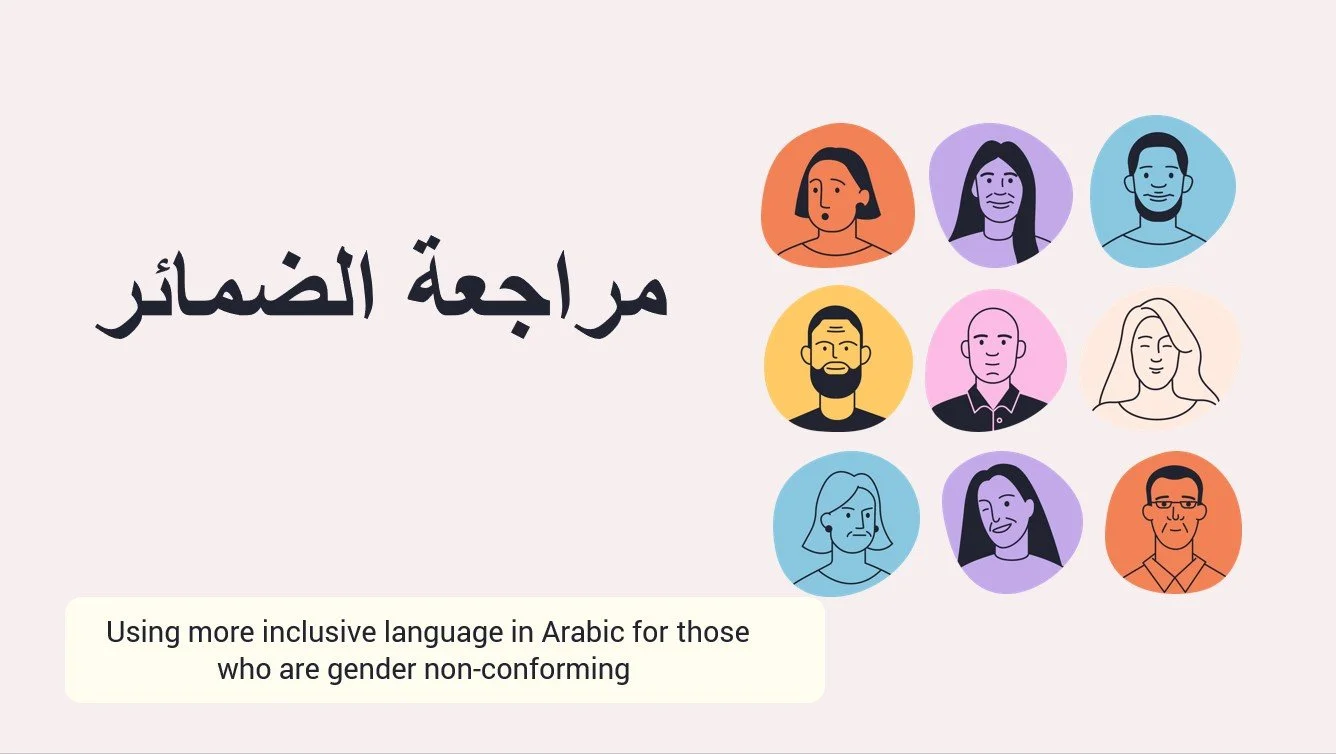
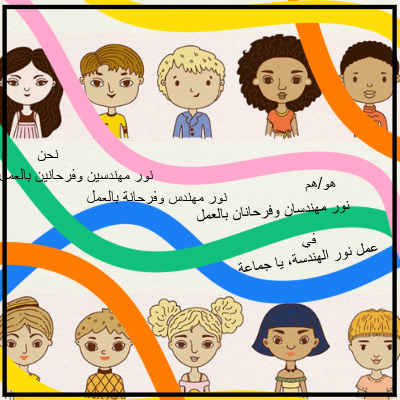
This page offers open educational resources for honoring people of all genders in Arabic. Below you will find both a presentation that reviews pronoun options (مراجعة الضمائر) and a document that presents pedagogical activities based on a survey of Arabic languagers whose genders exist outside of binary categories (أنشطة المسح).
This data-driven approach aligns with the core ideas of gender-just langauge pedagogies, which you can learn more about in this open access chapter, this open access journal article, and via the resources page of this site. By inviting students and colleagues into language exploration, we de-center power in the classroom and allow for more expansive possibilities as we do language and gender together (consult also Knisely & Russell, 2024 and the gender-just language education project primer).
The contents of this page were created by Maryah Converse, Lucie Knight, and Vess-Tessa, members of the Arabic language team, as part of the Gender-Just Language Education Project, coordinated and edited by Kris Knisely. You may cite these contents as follows:
Converse, Maryah, Knight, Lucie & Vess-Tessa. (2025). Arabic laguage materials. In Kris Knisely [Ed] The Gender-Just Language Education Project. krisknisely.com/resources-for-educators
This content is free to use, with attribution, for non-commercial purposes. You may share these resources, as long as you include a citation and link to this page.
Content under a CC-BY-NC-SA license.

The publications on this page are the result of a project from the Center for Educational Resources in Culture, Language and Literacy (CERCLL) at the University of Arizona. It was supported by a grant (P229A220011) from the U.S. Department of Education (CFDA 84.229A). Its contents do not necessarily represent the policy of the U.S Department of Education and you should not assume endorsement by the U.S. federal government. Its contents also do not necessarily represent the policy of the University of Arizona and you should not assume endorsement by the University of Arizona, the Arizona Board of Regents, or the government of the state of Arizona.
To return to the resources page click here.